如何在 Amazon EKS 和 SageMaker HyperPod EKS 上部署 NVIDIA Nemotron 模型
Accelerate agentic AI with NVIDIA Nemotron models on Amazon EKS and SageMaker HyperPod EKS
AWS 官方博客介绍在 Amazon EKS、EKS Auto Mode 和 SageMaker HyperPod EKS 上部署 NVIDIA Nemotron 系列模型的方法,涉及新加入 AWS 的 Nemotron 3.5 Super VL。
NVIDIA Nemotron 3.5 Super VL joins the NVIDIA Nemotron 3 Nano, Nano Omni, Super, Ultra, and Nemotron 3.5 Lightning models already available on AWS. It’s a 120B-parameter mixture-of-experts (MoE) model that activates 12B parameters per token. It combines reasoning and tool use with text, image, document, and video understanding, so one model serves both text and visual tasks. This post explores its architecture and use cases, then shows how to deploy it on Amazon Elastic Kubernetes Service (Amazon EKS), Amazon EKS Auto Mode, and Amazon SageMaker HyperPod EKS.
About Nemotron 3.5 Super VL
NVIDIA Nemotron 3.5 Super VL is an open multimodal model distilled from Nemotron 3 Ultra. NVIDIA publishes the weights, training datasets, and post-training recipes, so you can customize the model for domain-specific workloads and run it on infrastructure you control. Model details:
- 120B total parameters, 12B active per token.
- Hybrid Mamba-2, MoE, and attention layers with a RADIO vision encoder.
- Context length up to 1M tokens.
- Input: text, image, document, and video.
- Output: text.
- BF16 and NVFP4 checkpoints.
NVIDIA reports 63.44 percent on Hermes Bench and 87.05 percent on LangChain agent evaluations, and 80.8 percent on the CharXiv chart-reasoning benchmark. (technical report)
Model architecture
Nemotron 3.5 Super VL uses a hybrid Mamba-Transformer MoE architecture, interleaving Mamba-2, attention, and expert layers. Sparse routing activates 12B of the 120B parameters per token, so compute per token matches a much smaller model while GPU memory still holds the full weights. Mamba-2 layers carry a constant-size state during generation, so their memory does not grow with sequence length the way KV cache does, which keeps long contexts affordable. A recursively shared Multi-Token Prediction (MTP) head supports native speculative decoding.
Use cases
Nemotron 3.5 Super VL supports agent workflows that combine reasoning with visual understanding:
- Coding: test and validate code, analyze errors, recommend fixes.
- Web research: cross-reference and verify sources returned by search tools.
- Document intelligence: read tables, charts, and page layouts to produce summaries.
- Cyber security: identify vulnerabilities and triage threats.
- Video understanding: search, content, review, and incident analysis.
Nemotron 3.5 Super VL integrates with major open agent frameworks and orchestration systems through NVIDIA reference implementations, cookbooks, and the NVIDIA Agent Toolkit. For the full list of supported frameworks, see the NVIDIA developer blog.
Minimum GPU configurations
| vLLM (GPU Model / min count) | BF16 | NVFP4 |
| B200/GB200 | 8 | 2 |
| B300/GB300 | 4 | 1 |
| H200 | 8 | 4 |
| H100 | 16 | 8 |
Deployment on AWS
This section gives an overview of architecture, validation, and performance evaluation approaches. A detailed walkthrough of deploying Nemotron 3.5 Super VL and Nemotron 3 Ultra on AWS is available in the aws-do-eks project, including prerequisites, cluster creation, model weights download, deployment, testing, benchmarking, and cleanup. The same pattern can also be applied to other models in the NVIDIA Nemotron family.
Deployment architecture
The reference implementation runs on standard Amazon EKS, EKS Auto Mode, and SageMaker HyperPod EKS. With EKS Auto Mode, AWS manages scaling, GPU, and EFA support in the cluster on your behalf. The Kubernetes manifests for model deployment are the same for each of the orchestrator options. Each cluster has a control plane hosting the Kubernetes API and a data plane of CPU and GPU nodes. CPU nodes run system and test pods, while the GPU nodes run the model. Amazon Elastic Container Registry (Amazon ECR) stores the container images, a shared Amazon FSx for Lustre volume holds the model weights, and Elastic Fabric Adapter (EFA) connects the GPU nodes. The following figure shows a standard Amazon EKS cluster.
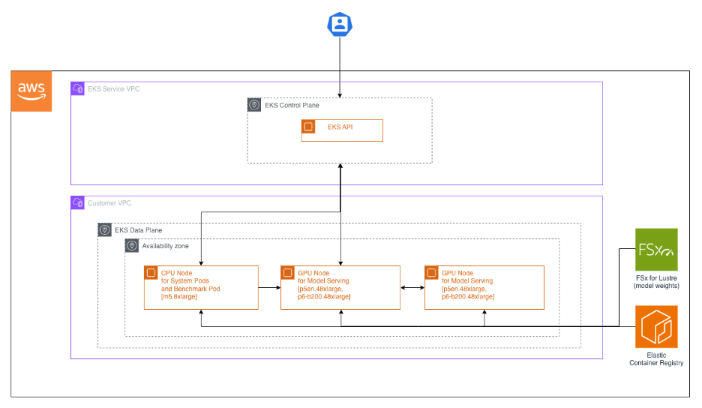
Figure 1: Standard Amazon EKS cluster architecture for serving NVIDIA Nemotron models
NVIDIA Dynamo serves the model aggregated on a single node or disaggregated with prefill and decode on different nodes. For vision-language models, the image/video encoding stage can in addition run disaggregated on its own node.
Validation and performance
This architecture has been validated on both p6-b200.48xlarge (8 x NVIDIA B200 GPUs) and p5en.48xlarge (8 x NVIDIA H200 GPUs) instances. You can validate the cluster and its network with an NVIDIA Collective Communications Library (NCCL) all-reduce micro-benchmark.
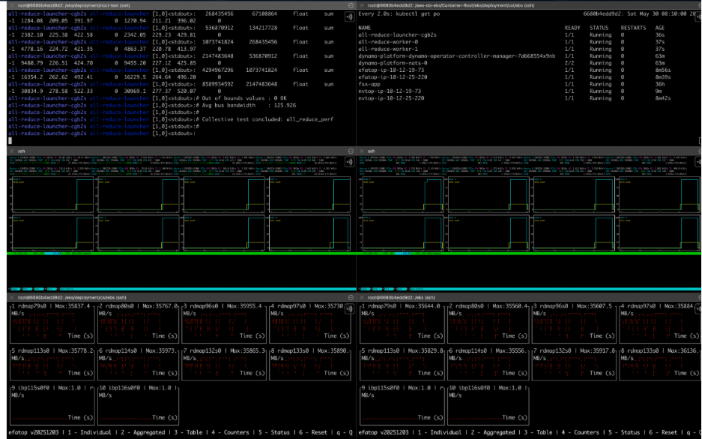
Figure 2: GPU and EFA utilization during an NCCL all-reduce validation test
Seeing utilization on all GPUs and traffic on all EFA adapters while the NCCL test is running, verifies that the cluster is working as expected.
You can measure the performance of a deployed model on the cluster with the NVIDIA aiperf tool.
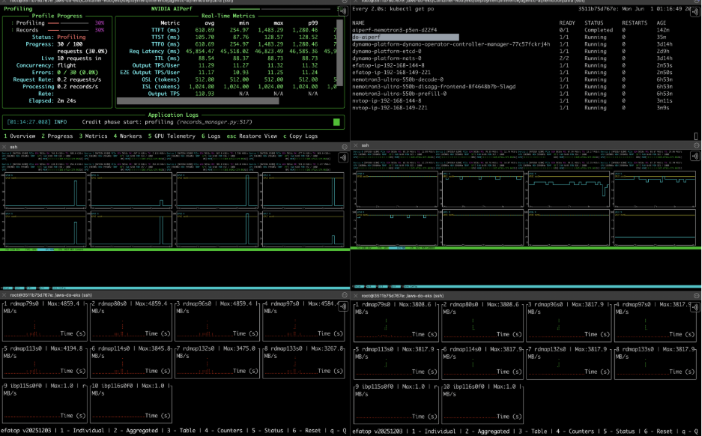
Figure 3: aiperf performance metrics for the deployed model
The aiperf output in the upper left pane shows key performance indicators (KPIs) like time to first token (TTFT), inter-token latency (ITL), and throughput in tokens per second (TPS). By taking these measurements at various levels of concurrency, we can study how latency and throughput depend on the number of concurrent requests. This information is essential to thoughtfully plan capacity and model deployment topology. The aws-do-eks container provides automation for visualizing GPU and EFA utilization as well as running aiperf and concurrency sweeps with single commands.
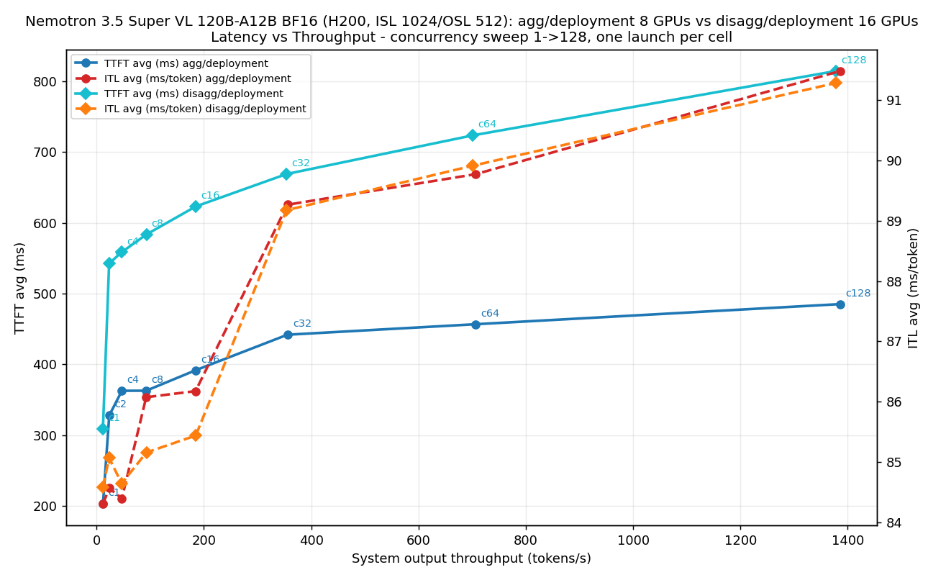
Figure 4: Concurrency sweep comparing aggregated and disaggregated deployments
The preceding concurrency sweep diagram reveals that the inference of Nemotron 3.5 Super VL has lower TTFT and about the same ITL between aggregated and disaggregated deployments on two nodes.
A chart like this is useful when making deployment decisions. Draw your latency budget as horizontal lines, for example TTFT under 600 ms (about 1 second) and ITL under 100 ms per token. The rightmost point under both lines is the throughput one replica of this topology can serve within the service level objective (SLO), here c32, or about 320 tokens per second. To plan capacity, divide your target tokens per second by this per-replica throughput and find the number of prefill-decode pairs to deploy. Re-running the same sweep after a change (precision, TP/PP shape, aggregated versus disaggregated, a new Dynamo or vLLM release) makes the trade-off visible immediately. A curve that moves right and down is a win. Because TTFT and ITL are plotted separately, it also tells you which side to scale: rising ITL says add decode capacity, and rising TTFT says add prefill capacity.
Conclusion
This post covers the architecture and performance evaluation patterns for serving NVIDIA Nemotron models on Amazon EKS, EKS Auto Mode, and SageMaker HyperPod EKS with NVIDIA Dynamo and vLLM. To get started, deploy Nemotron 3.5 Super VL in your own account, using the reference implementation. More inference blueprints are also available in the AI on EKS project. To get further hands-on experience with inference on EKS, register for our upcoming workshops.
Acknowledgements
The authors would like to convey special thanks to everyone involved in developing, validating, reviewing, and publishing this content, including but not limited to: Eliuth Triana, Jiahong Liu, Kshitiz Gupta, Abhijeet Patil, Mike Stefaniak, Chris Splinter, Sheetal Joshi, Aditya Ramakrishnan, Natarajan Kumar, Anish Maddipoti.
About the authors

Alex Iankoulski
Alex is a Principal Solutions Architect in the Worldwide Specialist Organization at AWS. He focuses on orchestration of AI/ML workloads using containers. Alex is the author of the do-framework and a Docker captain who loves applying container technologies to accelerate the pace of innovation while solving the world’s biggest challenges. Over the past 10 years, Alex has worked on helping customers do more on AWS, democratizing AI and ML, combating climate change, and making travel safer, healthcare better, and energy smarter.

Anton Alexander
Anton is a senior specialist in generative AI at AWS, focusing on scaling large training and inference workloads with Amazon SageMaker HyperPod. As a veteran CUDA programmer and Kubernetes expert, he helps enterprises integrate NVIDIA technologies for distributed training, specializing in EKS and Slurm implementations. Anton works closely with MENA Region and government sector clients to optimize generative AI solutions. He holds a patent pending for machine learning edge computing systems. Outside of work, Anton is a Brazilian jiu-jitsu and collegiate boxing champion who enjoys flying planes.

Leah Tucker
Leah is a Senior AI/ML Specialist Solutions Architect focusing on self-managed real-time inference using open-source models on EC2 and EKS. She specializes in inference engineering, model benchmarking, production architecture design, and optimizing performance from cold start to sustained throughput. Her recent work includes open-source TTS inference stacks on EKS and GPU benchmarking tools across the G and P instance families.

Curt Lockhart
Curt is an AI Solutions Architect at NVIDIA, where he helps customers across every part of the AI stack, from inference and training to agentic workflows. A teacher at heart enjoys making the complexities of AI feel approachable.

Abdullahi Olaoye
Abdullahi is a Senior AI Solutions Architect at NVIDIA, specializing in integrating NVIDIA AI libraries, frameworks, and products with cloud AI services and open-source tools to optimize AI model deployment, inference, and generative AI workflows. He collaborates with cloud providers to enhance AI workload performance and drive adoption of NVIDIA-powered AI and generative AI solutions.

Wenhan Tan
Wenhan is a solutions architect at NVIDIA, assisting customers in adopting NVIDIA AI solutions at large-scale. His work focuses on accelerating deep learning applications and addressing inference and training challenges.
来源:AWS Machine Learning Blog · aws.amazon.com